
ES-Rule-21-Phishing-User-Report-Mail
- An AI Agent built with Langgraph, including three Langgraph Nodes:
alert preprocessing,LLM analysis, andresult output. - The module is used to analyze phishing email samples reported by end-users, determine whether the email is a phishing email, its confidence level, the analysis process, and send the results to SIRP.
- It is recommended to refer to this module's code to develop Langgraph-type modules.
Import Test Alerts
All sample modules provided by ASF include test alert data located in DATA/{module_name}/mock_alert.py. Executing this script will import the test alert data into the Redis Stream.
Single Module & Single Alert Debugging
During module development, developers often need to debug a specific alert.
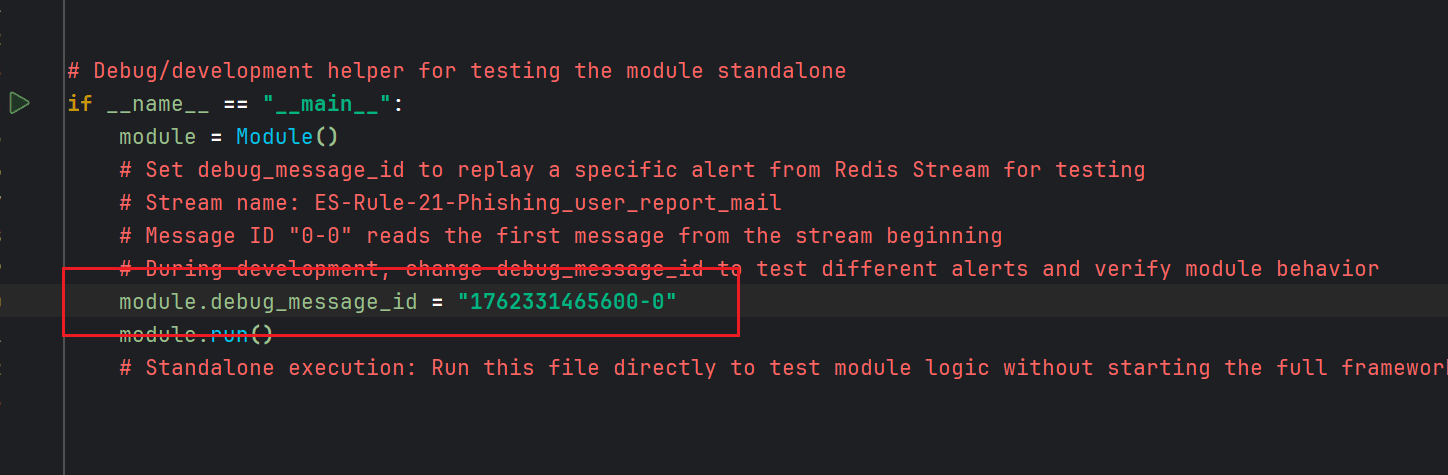
The ASP framework allows for debugging modules individually without starting the entire framework. The code can be found in the
if __name__ == "__main__":section of this module.Developers only need to find the corresponding Stream queue for the module in Redis Insight and get the ID of a specific alert.
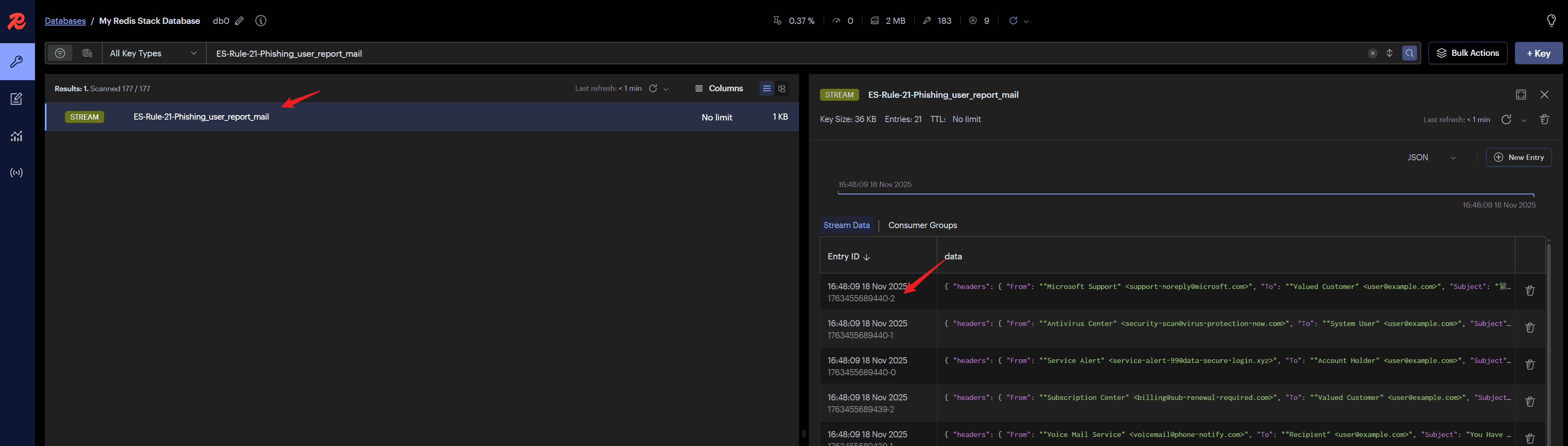
- Then assign the ID to the
module.debug_message_idvariable and run the module script to debug the alert.
Alert Aggregation (SIRP)
The GroupRule class is used for alert aggregation, combining multiple Alerts into a single Case based on a Rule. Refer to the code comments for usage.
Scenario 1
- The
ES-Rule-21-Phishing-User-Report-Mailrule in the SIEM platform sends metadata of all user-reported phishing emails as alerts to the Redis Stream. - The ASP module
ES-Rule-21-Phishing-User-Report-Mailuses an AI Agent built with Langgraph to analyze each alert, confirm if it is a phishing email, and format it into the SIRP Alert format. - We want to aggregate all phishing emails reported by the same sender within 24 hours into a single SIRP Case.
rule = GroupRule(
    rule_id=self.module_name,
    rule_name=rule_name,
    deduplication_fields=["mail_from"],
    deduplication_window="24h",
    source="Email",
workbook=workbook)deduplication_fieldsindicates which artifact of the Alert to use for aggregation (here, the sender).deduplication_windowindicates the time window for aggregating Alerts (here, 24h).- With aggregation, even if an attacker sends an email to multiple users, only one Case will be generated in SIRP, reducing the workload for analysts.
- Since all relevant information is added to the Case, analysts and AI Agents can easily access all data.
Scenario 2
- The
NDR-Rule-05-Suspect-C2-Communicationrule in the SIEM platform sends all network traffic suspected of C2 communication as alerts to the Redis Stream. - The ASP module
NDR-Rule-05-Suspect-C2-Communicationuses an AI Agent built with Langgraph to analyze each alert, confirm if it is suspected C2 communication, and format it into the SIRP Alert format. - We want to aggregate all alerts for suspected C2 communication from the same host within 1 hour into a single SIRP Case.
rule = GroupRule(
    rule_id=self.module_name,
    rule_name=rule_name,
    deduplication_fields=["hostname"],
    deduplication_window="1h",
    source="NDR",
    workbook=workbook
)
Analysts and summary-analysis AI Agents should process Alert collections (Cases) instead of individual Alerts to greatly improve analysis efficiency.